Guru Shishya Parampara in Astrology: Why It Matters
Key Takeaways
1. Guru Shishya Parampara means the tradition of the teacher and the student. It is the way Vedic knowledge, including Jyotish astrology, has been passed down through generations for thousands of years.
2. A Guru is not just a teacher who delivers information. A true Guru shapes the student's character, corrects their errors, and passes on wisdom that cannot be found in any book.
3. This tradition is why Vedic astrology is still alive and accurate today. Without it, the knowledge would have become stiff and mechanical rather than living and adaptable.
4. When you consult an astrologer who has been trained in this tradition, you are not just getting a chart calculation. You are receiving knowledge that has been refined and tested across many generations.
5. In the modern world, the Guru Shishya tradition has adapted. It lives on through serious mentorship, lineage-based training, and the relationship between experienced Jyotishis and their students.
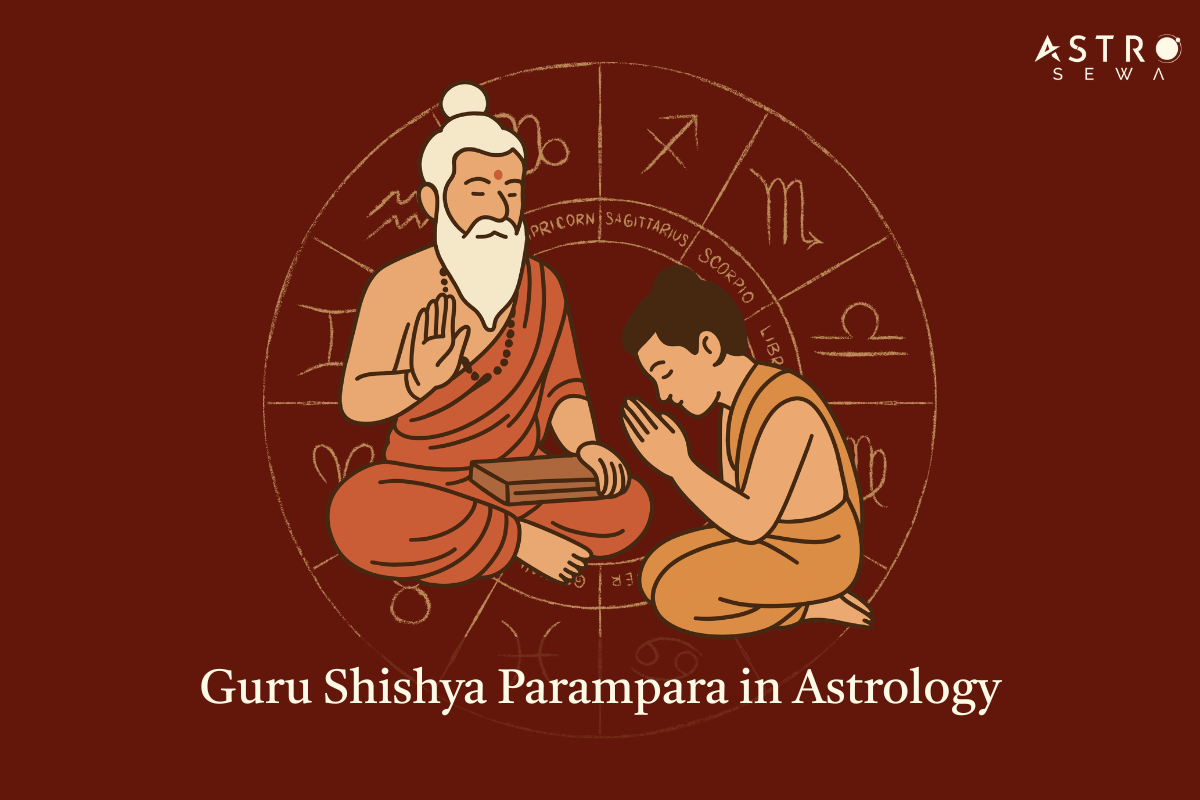
This way of learning, from teacher to student in a close and personal relationship, is one of the oldest and most important traditions in Indian culture. It is called the Guru Shishya Parampara. Guru means teacher or spiritual guide. Shishya means student or disciple. Parampara means tradition or lineage. Together, the phrase means the tradition of passing wisdom from teacher to student, from one generation to the next.
Why Is This Tradition So Important for Jyotish?
Vedic astrology is a particularly good example of knowledge that needs this kind of transmission. Jyotish is not a simple system. It contains 12 houses, 9 planets, 12 signs, 27 lunar mansions called Nakshatras, 16 divisional charts, a detailed planetary period system, and thousands of classical combinations described in texts that are hundreds of years old. Even after years of study, a student is still learning.
More importantly, knowing all of this information is not the same as being able to use it well. A birth chart contains so much information that reading it requires judgment: knowing which factors to prioritise, which combinations to take seriously, and which to weigh gently given everything else in the chart. This judgment cannot be learned from a rulebook. It develops through practice, feedback, and the guidance of someone who has already spent years developing it themselves.
The great Jyotish texts like the Brihat Parashara Hora Shastra and the Brihat Jataka were themselves compiled from oral teachings passed down through generations. The ancient sages did not sit alone and invent these systems. They received them from their own teachers, refined them through observation and practice, and passed them on. Every major lineage of Vedic astrology traces itself back through a chain of teachers and students that stretches across centuries.
This is why when you meet a Jyotishi who has been trained in a genuine lineage, there is often something different about the quality of their reading. They are not just applying rules from a book. They are drawing on a living tradition of accumulated wisdom that has been tested, corrected, and refined across many generations of real consultations with real people.
What Did the Traditional Training Actually Look Like?
In the traditional Guru Shishya model, a student who wanted to learn Jyotish would first approach a respected Guru with humility and sincerity.
Phase 1: Pre Observation of Shishya
The Guru would often observe the student for some time before accepting them, looking for qualities like honesty, genuine curiosity, patience, and a character that could be trusted with the kind of sensitive knowledge that astrology involves.
Phase 2: Consultations from Guru
Once accepted, the student would begin their training slowly. They might start by simply listening as the Guru conducted consultations, not participating but observing how questions were asked, how the chart was approached, and how guidance was given. Over time, the student would be asked to calculate charts, then to interpret individual planets and houses, then to attempt full readings that the Guru would then review, correct, and discuss.
Phase 3: Correction
This correction process was central to the tradition. The Guru's role was not just to praise when the student got things right but to identify precisely where their understanding was incomplete or where their judgment was off. A student might confidently predict a particular outcome from a chart combination, only to have the Guru point out three other factors that would significantly modify that prediction. Over years of these corrections, the student developed not just knowledge but genuine discernment.
Phase 4: Ethics and Art of Reading
The student also learned what might be called the ethics and art of the reading. How do you tell someone that their chart shows a difficult period ahead without making them feel helpless or frightened? How do you balance honesty with compassion? When do you focus on remedies rather than predictions? When is it better to encourage rather than to warn? These are questions with no rulebook answers, and they were learned by watching, by making mistakes, and by the Guru's patient guidance over time.
How Is This Tradition Different from Just Reading Books or Taking Courses?
In the modern world, there are many ways to learn astrology. There are online courses, YouTube videos, books in every language, apps that explain chart placements, and forums where people share interpretations. All of these have value and can give someone a solid intellectual foundation in Jyotish. But there are things they cannot provide that the Guru Shishya tradition specifically can.
None of this means that self-study or online learning is without value. Many serious modern Jyotishis have supplemented their formal training with books, courses, and their own research. But there is a significant difference between someone who has learned entirely from books and someone who has sat with an experienced Jyotishi for years, watched them read hundreds of charts, been corrected on their interpretations, and absorbed the living texture of the tradition. That difference shows up in the quality of a reading.
Frequently Asked Questions
What does Guru Shishya Parampara mean in simple words?
It means the tradition of the teacher and the student. Guru means teacher, Shishya means student, and Parampara means tradition or lineage. It refers to the ancient Indian way of passing knowledge from one generation to the next through a close personal relationship between teacher and student, rather than just through books or formal classes. This tradition is how Vedic astrology and many other branches of Indian knowledge have been kept alive for thousands of years.
Why does this tradition matter for astrology specifically?
Vedic astrology contains an enormous amount of information, and knowing that information is not the same as being able to use it well. Reading a birth chart requires judgment: knowing which factors matter most, how to weigh them against each other, and how to communicate sensitive findings with honesty and care. This kind of judgment only fully develops through years of practice, ideally guided by someone experienced. Books can give you the rules. A Guru gives you the wisdom to apply them well.
Does every good Jyotishi have a Guru?
Not necessarily in the traditional residential sense, but most serious and skilled Jyotishis have learned from someone more experienced than themselves, had their readings reviewed and corrected over time, and carry the influence of a lineage even if they have not followed the full traditional model. The spirit of the tradition matters more than the precise form it takes. What distinguishes a Guru-trained astrologer is not just what they know but how carefully and ethically they use what they know.
What is Jupiter's connection to the Guru tradition in astrology?
In Vedic astrology, Jupiter is literally called Guru. He is the planet of teachers, wisdom, higher knowledge, and the divine principle of guidance. His placement in your birth chart shows where teachers and mentors are likely to play an important role in your life. The 9th house, which Jupiter naturally governs in the cosmic chart, is specifically the house of the Guru, of dharma, and of the blessings that come through honouring teachers and tradition. A strong Jupiter in the 9th house is often found in the charts of people who both receive and give real wisdom.
How can I tell if an astrologer has been trained in this tradition?
Ask them directly how they learned astrology and from whom. A Jyotishi trained in the parampara tradition will typically mention a specific teacher or lineage, be able to describe years of supervised practice, and show familiarity with classical texts like Brihat Parashara Hora Shastra rather than just modern popularisations. The quality of their reading also speaks for itself: a lineage-trained astrologer tends to be more careful, more nuanced, and more honest about uncertainty than someone who has learned primarily from apps or general online courses.
Are the astrologers on Astrosewa trained in this tradition?
The astrologers on Astrosewa are trained practitioners of Vedic Jyotish who bring real experience and depth to their readings. They work from the classical Vedic tradition, study primary texts, and approach each chart with the seriousness and care that good Jyotish requires. When you book a reading on Astrosewa, you receive a personalised, thoughtful reading from a real person who has studied this tradition seriously, not an automatically generated report.