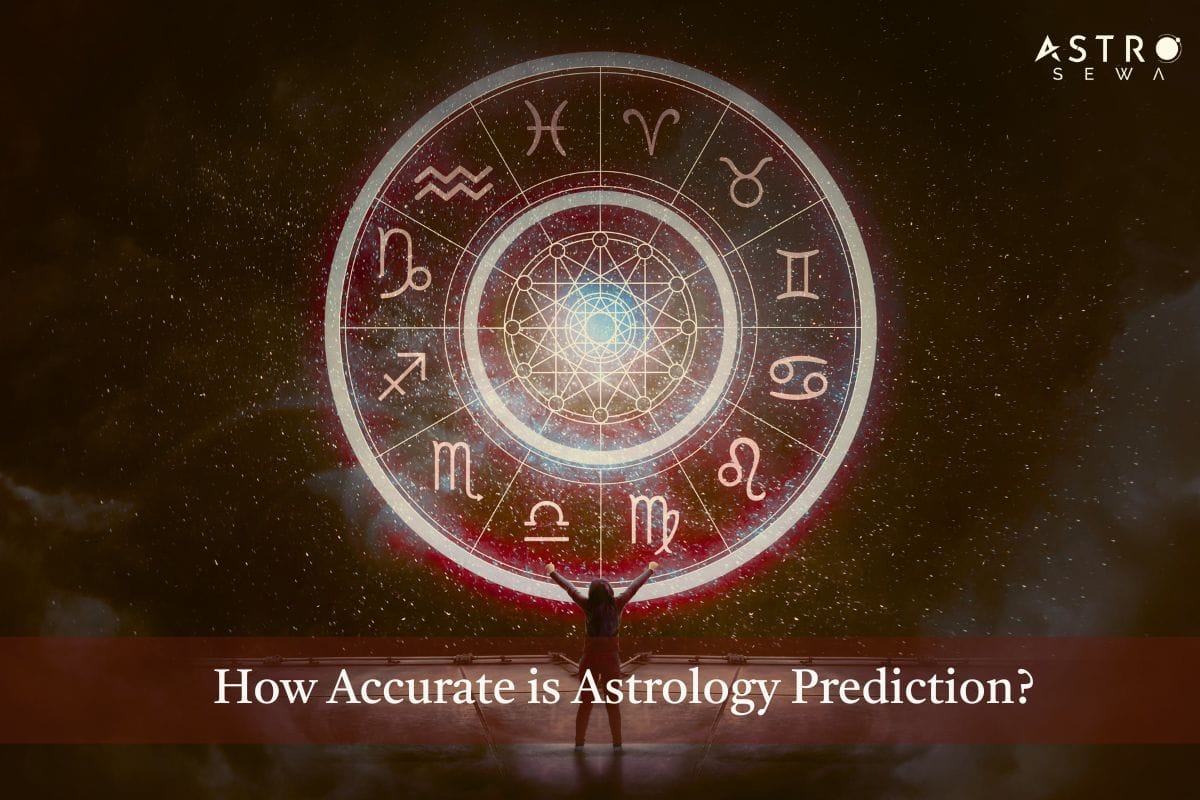
How Accurate Is Astrology Prediction?
Key Takeaways
1. Vedic astrology does not predict exact events like a script. It shows tendencies, timing windows, and the general shape of what is coming in different areas of your life.
2. Accuracy is highest in areas like career timing, financial periods, and health vulnerability. It is lower for very specific details like exact dates or other people's choices.
3. The quality of the reading depends on three things: your exact birth time, the skill of the astrologer, and which system of astrology they are using.
4. Vedic astrology's timing system, called the Dasha system, is what makes it unusually precise. It tells you not just what may happen but roughly when.
5. Astrology predictions are not fixed. Your choices, the remedies you follow, and your own effort can change how events unfold even when the chart shows a difficult period.
If you have ever sat in front of an astrologer, or even just read your horoscope online, you have probably wondered: how much of this is actually true? It is a fair question, and it deserves a fair answer. Not the overpromising kind where everything is certain, and not the dismissive kind where astrology is written off as guesswork. The real answer lies somewhere more interesting.
Vedic astrology has been practised and refined for over 5,000 years. Generations of astrologers have observed the connection between planetary positions at the time of birth and the events and tendencies that unfold in a person's life.
What they developed is not a system for predicting your future word for word. It is a system for reading patterns: the broad themes that are likely to come up in your life, the areas where you are naturally strong or vulnerable, and the periods of time when particular events are most likely to happen.
What Astrology Is Actually Predicting?
To understand accuracy, it helps to be clear about what a Vedic astrologer is actually doing when they read your chart. They are not reading a fixed script of your future. They are reading the karmic patterns written into your birth chart and matching those patterns to a timing system called the Dasha system, which shows which planet is running your life at any given time.
Your birth chart is a snapshot of the sky at the exact moment you were born. Each planet's position at that moment is connected to different areas of your life: your career, your relationships, your health, your finances, and so on.
When a planet that rules one of these areas enters a difficult period in your Dasha cycle, that area of life is more likely to face challenges. When it enters a favourable period, that area is more likely to improve.
So what the astrologer is predicting is not a specific event. They are predicting a time window when a particular type of experience is more likely to arrive. A good astrologer might say: between this year and next, your career house is under pressure from Saturn, so be careful about job stability and avoid major professional risks during this window. That is a useful and often accurate prediction. What they cannot say is: you will be fired on the 14th of March.
Where Astrology Tends to Be Most Accurate?
Across thousands of readings, certain areas of life show up as consistently well-predicted by Vedic astrology. Career and financial timing are among the strongest. Clients regularly report that the periods their astrologer flagged as difficult for their job or money turned out to be exactly when problems arrived, and that the periods marked as favourable did bring real improvements.
Relationship timing is another area where Vedic astrology performs well. The timing of marriage, periods of relationship stress, and the likelihood of separation can be read with reasonable accuracy from the 7th house and the planets connected to it. Health vulnerability periods, particularly around Saturn and Rahu transits, also show up with notable regularity in clients' experience.
The table below gives a clear picture of where Vedic astrology tends to be more reliable and where its accuracy is more limited.
Why Birth Time Matters So Much?
One of the biggest factors in how accurate a reading turns out to be is the birth time. In Vedic astrology, even a difference of a few minutes can change the rising sign, which shifts the entire house structure of the chart. If your rising sign is wrong, every house in the chart shifts, and predictions about career, relationships, and health can all point in the wrong direction.
This is why serious Vedic astrologers always ask for the birth time and treat an uncertain or approximate time as a real limitation. If you were born in a hospital, your birth time is usually recorded on your birth certificate or hospital records.
If you do not have it, a skilled astrologer can sometimes use a technique called birth time rectification, where they work backward from known life events to narrow down the most likely birth time. But predictions made without a confirmed birth time will always carry a higher margin of uncertainty.
Birth date and place also matter, but birth time is the most sensitive of the three. If you want the most accurate reading possible, tracking down your exact birth time is the single best thing you can do before booking a consultation.
The Astrologer Makes a Big Difference
Another honest truth about accuracy is that it depends heavily on who is doing the reading. Vedic astrology is a deep and complex system. It takes years of serious study to read a chart well, and the difference between a skilled astrologer and an inexperienced one can be very significant.
A good astrologer reads multiple layers of the chart at once: the positions of all the planets, the house each one rules, the current Dasha period and its sub-period, the transits of slow-moving planets like Saturn and Jupiter, and the divisional charts that zoom in on specific life areas. They also know how to balance all these factors and give you a reading that reflects the overall picture rather than picking out only the scary parts or only the good ones.
An astrologer who bases their reading mostly on your Sun sign, or who makes very dramatic predictions without looking at the full chart, is likely to be less accurate and less helpful. When looking for a consultation, ask whether the astrologer works with your full birth chart including your rising sign and current planetary period. Those are the markers of a thorough, serious reading.
Can Predictions Be Wrong?
Yes, and any honest astrologer will tell you so. Predictions can be wrong for a few reasons. Sometimes the birth data is inaccurate, particularly if the birth time is uncertain. Sometimes the astrologer misreads the chart or weighs the factors incorrectly. And sometimes life simply unfolds in a way that the chart did not fully capture, because no system, however ancient and refined, can account for every variable in a human life.
There is also the factor of your own choices. Vedic astrology does not believe you are a puppet of your planets. It believes you have the capacity to work with your chart consciously. Two people with identical charts can have very different life outcomes because of the choices they make and the effort they put in.
A chart that shows a difficult financial period does not mean money problems are certain. It means that period requires extra care, better planning, and possibly following certain remedies that reduce the karmic pressure.
This is actually one of the most empowering aspects of Vedic astrology. The prediction is not a verdict. It is a heads-up. And a heads-up gives you the chance to prepare.
What Makes Vedic Astrology More Precise Than Other Systems
Among the various astrological traditions around the world, Vedic astrology stands out for the precision of its timing system. The Dasha system assigns each person a sequence of planetary periods based on the Moon's position at birth. Each planet gets a specific number of years, and within that main period there are smaller sub-periods that narrow the timing down further.
This means a Vedic astrologer can often tell you not just that something is likely to happen but when it is most likely to happen, within a window of months rather than just years. Western astrology uses transits and progressions for timing, which are also useful, but the Dasha system adds a layer of specificity that most clients find genuinely striking when they look back and see how closely the timing matched real events in their life.
The sidereal zodiac used in Vedic astrology, which aligns the planets with the actual positions of the stars in the sky, also adds to its precision. Combined with the system of divisional charts that examine specific life areas in detail, Vedic astrology gives a trained practitioner a very rich set of tools for producing readings that go well beyond broad personality descriptions.