Shiva Puja Vidhi: 17 Step-by-Step Guide with Mantras

Key Takeaways
1. Shiva Puja can be performed daily, on Mondays (Somwar), during Pradosh Kaal, on Shivaratri, and throughout the month of Shravan. Monday is the most auspicious day.
2. The core of Shiva Puja is Abhishek, the ritual bathing of the Shivling with Gangajal and Panchamrit (milk, curd, ghee, honey, sugar). This single act alone constitutes a complete and valid puja.
3. Bilva leaves (Bel patra) are the most sacred offering to Shiva. Offering them with Om Namah Shivaya is said to remove the sins of three lifetimes.
4. Om Namah Shivaya is the Panchakshara Mantra, the primary mantra of Shiva. Chanting it 108 times daily is one of the most powerful spiritual practices in the Shaiva tradition.
5. The Maha Mrityunjaya Mantra is chanted during Shiva Puja for health, longevity, and protection from death and fear.
People often think Shiva Puja requires a pundit, an elaborate setup, or hours of preparation.
It does not.
Shiva is the simplest deity to worship. He accepted the devotion of a hunter who offered him leaves by mistake. He blessed a thief who climbed a Bilva tree to hide and accidentally dropped leaves on a Shivling below. What Shiva responds to is not ceremony. It is sincerity.
That said, when you do perform Shiva Puja with the right steps and the right mantras, the experience deepens significantly. This guide gives you everything you need, from the complete samagri list to every step of the Shodashopachara Puja (sixteen-step worship), with all mantras written out clearly.
Why Perform Shiva Puja?
Lord Shiva is the Mahadeva, the greatest of all gods. He is the destroyer and the transformer, the one who removes what is old and creates space for what is new. He represents pure consciousness, the awareness beneath all existence.
Worshipping Shiva brings:
• Relief from suffering, illness, and bad karma
• Removal of obstacles in career and personal life
• Protection from enemies and negative energies
• Blessings for a good marriage and harmonious relationships
• Powerful relief during Saturn Dasha, Sade Sati, and Rahu-Ketu periods
• Spiritual growth and progress toward moksha
• Long life and freedom from fear of death
In Vedic astrology, Shiva is directly connected to Saturn (Shani). Worshipping Shiva is one of the most powerful remedies for Saturn-related difficulties. If you are going through Sade Sati or a difficult Shani Mahadasha, Shiva Puja is your most direct line of relief.
Best Time to Perform Shiva Puja
Most Auspicious Days
• Monday (Somwar): Shiva's own day. Puja on Monday is exceptionally powerful.
• Pradosh Vrat: The 13th Tithi (Trayodashi) of each lunar fortnight, especially at twilight
• Monthly Shivaratri: Krishna Chaturdashi every lunar month
• Maha Shivaratri: The greatest night of Shiva worship in the entire year
• Shravan month (July to August): Every day is auspicious, especially Mondays
Best Times of Day
• Brahma Muhurta (before sunrise): The most spiritually powerful time of day
• Pradosh Kaal (evening twilight): Especially sacred for Lord Shiva
• Noon: Acceptable for daily home puja when morning is not possible
Shiva Puja Samagri: Complete Materials List
Gather everything before you begin. Leaving midway to find an item breaks the puja's flow and focus.
|
Samagri Item |
Purpose in Shiva Puja |
|
Shivling |
The sacred symbol of Lord
Shiva; the centrepiece of the puja |
|
Gangajal or clean water |
For Abhishek, the ritual
bathing of the Shivling |
|
Panchamrit |
Milk, curd, honey, ghee,
and sugar combined for the sacred bath |
|
Bilva leaves (Bel patra) |
Three-leafed sacred
leaves; must be unbroken and hole-free |
|
White flowers |
Dhatura, white lotus, Aak
(Madar), or any white flowers |
|
Sandalwood paste
(Chandan) |
Applied to the Shivling
for cooling and fragrance |
|
Vibhuti (sacred ash) |
Applied to the Shivling
and on the devotee's forehead as tilak |
|
Dhupa (incense sticks) |
For purification and
fragrance of the worship space |
|
Diya (oil lamp) |
Lit with ghee or sesame
oil; used for Aarti |
|
Camphor (Kapoor) |
For lighting during
Aarti; creates an intense sacred flame |
|
Akshat (unbroken rice) |
Mixed with kumkum and
offered to the deity |
|
Fruits or Prasad |
Coconut, banana, or
seasonal fruits as Naivedyam |
|
Rudraksha mala |
For counting mantra
repetitions during japa |
|
Puja thali (plate) |
To hold all offering
items neatly during the puja |
|
Bell (Ghanta) |
Rung at the start of
worship and during Aarti |
Shiva Puja Vidhi: Complete Step-by-Step Procedure
The complete form is the Shodashopachara Puja, sixteen steps of worship drawn from the Shaiva Agamas and the Shiva Purana. This takes 30 to 60 minutes. A simplified daily version is given after. Before You Begin:
• Take a bath and wear clean clothes, preferably white or light-coloured
• Clean the puja space and wipe the Shivling with a clean damp cloth
• Arrange all samagri on the puja thali in front of the Shivling
• Light the diya and incense sticks
• Sit facing north or east in a comfortable position
• Take three slow deep breaths and bring your full attention to the present moment
Step 1: Achaman (Purification of Self)
Sip a small amount of water three times from your right palm while chanting:
|
Achaman Mantra: Om Keshavaya Namah | Om Narayanaya Namah | Om Madhavaya Namah Meaning: Purifies the body and mind before worship |
Step 2: Sankalp (Statement of Intention)
Hold water in your right palm with a flower and some rice. State your name, the occasion, and the purpose of your puja clearly in your mind or aloud. Then release the water into a plate.
Example: "I, [your name], perform this Shiva Puja today for the health, peace, and blessings of Lord Mahadeva for myself and my family."
Step 3: Dhyana (Meditation on Lord Shiva)
Close your eyes. Visualise Lord Shiva seated in deep meditation on Mount Kailash. He wears a crescent moon, the Ganga flows from his matted hair, a serpent coils around his neck, and he holds the Trishul. His body is smeared with sacred Vibhuti ash.
|
Shiva Dhyana Mantra: ध्यायेन्नित्यं महेशं रजतगिरिनिभं चारुचन्द्रावतंसं Dhyayennityam Mahesham Rajatagirinibham Charu Chandravatamsam Meaning: I meditate always on the great Lord Shiva, radiant as
a silver mountain, adorned with the beautiful crescent moon |
Step 4: Avahana (Invocation)
Invoke Lord Shiva's presence into the Shivling with folded hands:
|
Avahana Mantra: आगच्छ देव देवेश तेजोराशे जगत्पते। Agaccha Deva Devesh Tejorashi Jagatpate, Kriyamanam Maya Pujam
Grihana Surasattama Meaning: O Lord of Lords, please come and accept the puja I
offer with devotion |
Step 5: Padyam (Water for Feet)
Offer water at the base of the Shivling as if washing the Lord's feet:
|
Padyam Mantra: Om Namah Shivaya — Padyam Samarpayami Meaning: I offer water to wash Your holy feet, O Shiva |
Step 6: Arghyam (Water for Hands)
|
Arghyam Mantra: Om Namah Shivaya — Arghyam Samarpayami Meaning: I offer water to refresh Your sacred hands, O Shiva |
Step 7: Achamaniyam (Water for Sipping)
|
Achamaniyam Mantra: Om Namah Shivaya — Achamaniyam Samarpayami Meaning: I offer pure water for Your sacred lips, O Shiva |
Step 8: Abhishek (The Sacred Bath)
This is the heart of Shiva Puja. Pour Gangajal or clean water over the Shivling in a continuous slow stream while chanting Om Namah Shivaya throughout.
Then perform Panchamrit Abhishek with the five sacred substances in sequence:
|
Panchamrit Item |
Spiritual Meaning |
Mantra While Pouring |
|
Milk (Dugdha) |
Purity and nourishment.
Represents Sattvic energy. |
Om Namah Shivaya —
Dugdhena Snanam Samarpayami |
|
Curd (Dadhi) |
Prosperity and
transformation. Symbol of abundance. |
Om Namah Shivaya —
Dadhina Snanam Samarpayami |
|
Ghee (Ghruta) |
Purification and clarity.
Represents light. |
Om Namah Shivaya —
Ghritena Snanam Samarpayami |
|
Honey (Madhu) |
Sweetness in life.
Represents the nectar of wisdom. |
Om Namah Shivaya —
Madhuna Snanam Samarpayami |
|
Sugar (Sharkara) |
Bliss and divine
sweetness. Joy of devotion. |
Om Namah Shivaya —
Sharkaraya Snanam Samarpayami |
After the five Panchamrit offerings, pour plain Gangajal over the Shivling to complete the bath:
|
Final Bath Mantra: Om Namah Shivaya — Shuddhodakena Snanam Samarpayami Meaning: I offer pure water for Your complete and cleansing
bath, O Shiva |
Step 9: Vastram (Offering of Cloth)
Offer a piece of clean white cloth or sacred thread. If not available, simply touch the Shivling with folded hands:
|
Vastram Mantra: Om Namah Shivaya — Vastram Samarpayami Meaning: I offer sacred clothing to adorn You, O Shiva |
Step 10: Gandham (Sandalwood Paste)
Apply sandalwood paste (Chandan) gently to the Shivling with your ring finger:
|
Gandham Mantra: श्रीखण्डं चन्दनं दिव्यं गन्धाढ्यं सुमनोहरम्। Shrikhandam Chandanam Divyam Gandhadhyam Sumanoharam,
Vilepanam Surashrestha Chandanam Pratigrihyatam Meaning: O best of gods, please accept this divine fragrant
sandalwood paste |
Step 11: Vibhuti and Akshat (Sacred Ash and Rice)
Apply Vibhuti to the Shivling, then offer unbroken rice grains mixed with kumkum:
|
Akshat Mantra: Om Namah Shivaya — Akshatan Samarpayami Meaning: I offer sacred grains, symbol of abundance and
completeness |
Step 12: Pushpam (Flowers and Bilva Leaves)
Bilva leaves first. Hold three Bilva leaves with the smooth side facing up and the stem pointing toward you. Place them at the base of the Shivling one by one:
|
Bilva Patra Mantra: त्रिदलं त्रिगुणाकारं त्रिनेत्रं च त्रियायुधम्। त्रिजन्मपापसंहारं एकबिल्वं शिवार्पणम्॥ Tridalam Trigunakaram Trinetra Cha Triyayudham,
Trijanmapapasanharam Ekabilwam Shivarpanam Meaning: I offer one Bilva leaf to Shiva, which removes the
sins of three lifetimes |
After Bilva leaves, offer white flowers, Dhatura flowers, and any other sacred flowers while chanting Om Namah Shivaya for each offering.
Step 13: Dhupa and Dipa (Incense and Lamp)
Wave lit incense sticks before the Shivling in a clockwise circle three times. Then wave the diya in the same way:
|
Dhupa-Dipa Mantra: Om Namah Shivaya — Dhupam Samarpayami | Om Namah Shivaya —
Dipam Samarpayami Meaning: I offer fragrant incense and sacred light to please
Your divine senses |
Step 14: Naivedyam (Food Offering)
Place fresh fruits, coconut, or simple food in front of the Shivling on a clean plate. Sprinkle water around it, then offer with:
|
Naivedyam Mantra: Om Namah Shivaya — Naivedyam Samarpayami Meaning: I offer this food with love and devotion for Your
acceptance, O Shiva |
Step 15: Mantra Japa (Chanting)
Sit quietly with your Rudraksha mala. Chant the Panchakshara Mantra 108 times, one bead per repetition.
|
Panchakshara Mantra
(Primary Mantra of Shiva): ॐ नमः शिवाय Om Namah Shivaya Meaning: I bow to Shiva. The five syllables Na-Ma-Shi-Va-Ya
represent the five elements: earth, water, fire, air, and ether. |
|
Maha Mrityunjaya Mantra
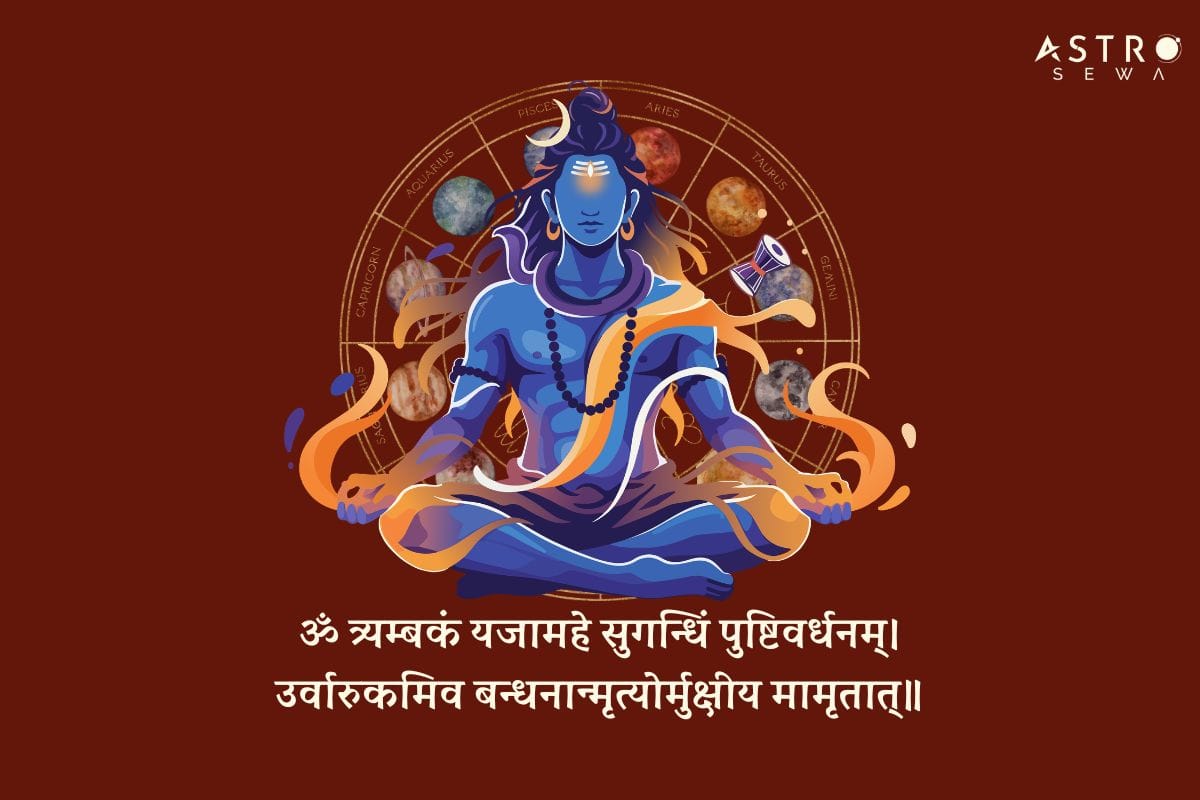
(For Health and Liberation): ॐ त्र्यम्बकं यजामहे सुगन्धिं पुष्टिवर्धनम्। उर्वारुकमिव बन्धनान्मृत्योर्मुक्षीय माऽमृतात्॥ Om Tryambakam Yajamahe Sugandhim Pushtivardhanam, Urvarukamiva
Bandhanan Mrityor Mukshiya Mamritat Meaning: We worship the three-eyed Lord Shiva who nourishes
all. May He free us from death as a ripe cucumber is freed from its vine, and
grant us immortality |
Step 16: Aarti (Closing Worship with Flame)
Take the Aarti thali with lit camphor or a diya. Ring the bell in your left hand. Wave the flame clockwise before the Shivling: four circles for the feet, two for the stomach, one for the face, then seven circles for the complete form.
|
Shiv Aarti: जय शिव ओंकारा, स्वामी जय शिव ओंकारा। ब्रह्मा, विष्णु, सदाशिव, अर्द्धांगी धारा॥ Jai Shiv Omkaara, Swami Jai Shiv Omkaara, Brahma Vishnu
Sadashiv, Ardhangee Dhara Meaning: Victory to Shiva, the sacred sound Om. Brahma,
Vishnu, and Shiva are one, and Shakti is his half |
After Aarti, hold the flame near the Shivling, then bring the thali to yourself and pass your palms briefly over the flame to receive the warmth as Prasad.
Step 17: Pradakshina and Visarjan (Circumambulation and Close)
Take half a Pradakshina of the Shivling. Do not cross the water channel (Yoni). Walk from one side to the other and back. Then bow completely with your forehead touching the ground.
Conclude the puja with Visarjan:
|
Visarjan Mantra: Gaccha Gaccha Param Sthanam Shambho Svamandiram, Punarapi Tvam
Ihaagaccha Bhaktanam Pujaya Punah Meaning: Return to your divine abode, O Shiva. Come again when
your devotees call upon you with love |
Simplified Daily Shiva Puja: 10 to 15 Minutes
The complete Shodashopachara Puja takes 30 to 60 minutes. For daily practice, this short version is equally valid:
• Take bath and come to the puja space in clean clothes
• Light a diya and incense sticks
• Pour Gangajal or clean water over the Shivling in a slow continuous stream
• Offer three Bilva leaves with Om Namah Shivaya
• Chant Om Namah Shivaya 108 times on a Rudraksha mala
• Chant the Maha Mrityunjaya Mantra 11 times
• Offer a flower and bow in gratitude
This simple daily practice, maintained consistently, is more powerful than an elaborate puja performed occasionally. Shiva values regularity and sincerity over grandeur.
Somwar Vrat: Monday Fasting for Shiva
How to Observe Somwar Vrat
• Wake up early, bathe, and wear white or light-coloured clothes
• Perform Shiva Puja at home or visit a Shiva temple
• Fast throughout the day, breaking only in the evening
• Eat only Sattvic food: fruits, milk, sabudana, or simple vegetarian
• Chant Om Namah Shivaya throughout the day when possible
• Read or listen to the Somwar Vrat Katha
• Break the fast after evening puja with Prasad and light food
Observing Somwar Vrat for 16 consecutive Mondays (Solah Somwar Vrat) is especially powerful for unmarried people seeking marriage and for all devotees seeking Shiva's sustained grace.
What Not to Do During Shiva Puja
• Do not offer Tulsi (Holy Basil) leaves. Tulsi is sacred to Lord Vishnu, not Shiva.
• Do not apply Haldi (turmeric) directly on the Shivling.
• Do not offer Ketaki flowers. These are specifically forbidden in the Puranas.
• Do not take a full circle Pradakshina of the Shivling. Only half Pradakshina is correct.
• Do not use Bilva leaves with holes, that are dried, or that have fewer or more than three leaflets.
• Do not perform puja without bathing or with impure hands.
Shiva Puja as an Astrological Remedy
In Vedic astrology, Shiva Puja is one of the most powerful remedies available. It is prescribed for:
• Saturn (Shani) difficulties: Shiva is Saturn's deity. Shiva Puja directly reduces Saturn's afflictions.
• Sade Sati: Abhishek with Gangajal on Mondays and Saturdays is one of the strongest Sade Sati remedies.
• Rahu and Ketu Mahadasha: Maha Mrityunjaya Mantra japa is especially prescribed during these periods.
• Manglik Dosha: Rudra Abhishek on Tuesdays is a traditional Mars remedy.
• General Papa Graha effects: Bilva leaf offerings are said to clear accumulated karmic debt.
Conclusion
Shiva Puja does not require a perfect ceremony. It requires a sincere heart.
Every drop of water poured on the Shivling with devotion reaches Shiva. Every Bilva leaf offered with a quiet mind is accepted. Every repetition of Om Namah Shivaya moves you closer to the stillness that Shiva himself represents.
Whether you perform the complete Shodashopachara Puja or simply sit before a Shivling with a glass of water and a quiet mind, you are in exactly the right place.
Har Har Mahadev.
Frequently Asked Questions
What is Shiva Puja Vidhi?
Shiva Puja Vidhi is the complete step-by-step procedure for worshipping Lord Shiva. It includes preparation, Sankalp (statement of intention), Dhyana (meditation), Abhishek (ritual bathing with Panchamrit and water), offering of Bilva leaves and flowers, mantra chanting including Om Namah Shivaya and the Maha Mrityunjaya Mantra, Aarti, Pradakshina (circumambulation), and Visarjan (closing the puja). The complete sixteen-step form is called Shodashopachara Puja.
Which day is best for Shiva Puja?
Monday (Somwar) is the most auspicious day. Shiva is the presiding deity of Monday and worship on this day is considered especially powerful. Other highly auspicious times include Pradosh Kaal (evening twilight on the 13th Tithi), monthly Shivaratri, Maha Shivaratri, and the entire month of Shravan. For daily puja, early morning before sunrise (Brahma Muhurta) is the most spiritually potent time of day.
What is the most important mantra in Shiva Puja?
Om Namah Shivaya is the Panchakshara Mantra, the five-syllable primary mantra of Shiva. Its five syllables Na-Ma-Shi-Va-Ya represent the five elements: earth, water, fire, air, and ether. This mantra can be chanted at any time, during Abhishek, while offering flowers, or in daily life. The Maha Mrityunjaya Mantra is equally important, specifically chanted for health, protection, and freedom from the fear of death.
Can Shiva Puja be done at home without a Shivling?
Yes. If you do not have a Shivling, you can use a Shaligram, a smooth round stone from a sacred river, or a small mound of earth or sand as a temporary Shivling. An image or picture of Lord Shiva also works completely well for home worship. The sincerity of the devotee matters more than the physical setup. Shiva is Bholenath, the innocent lord. He accepts worship in whatever form is available.
Why are Bilva leaves the most important offering for Shiva?
Bilva leaves (Bel patra) are Shiva's most beloved offering. The three leaflets represent the Trimurti (Brahma, Vishnu, Shiva), the three Gunas (Sattva, Rajas, Tamas), and Shiva's three eyes. The Bilva Patra mantra states that offering even a single three-leafed Bilva destroys the sins of three lifetimes. Shiva is specifically said to be more pleased by Bilva leaves than by any other offering. Always use three-leafed, unbroken Bilva leaves with the smooth side facing up.
What is Panchamrit Abhishek?
Panchamrit Abhishek is the ritual bathing of the Shivling with five sacred substances: milk, curd, ghee, honey, and sugar. Each substance is poured separately with its own mantra while chanting Om Namah Shivaya. After all five are offered, the Shivling is rinsed with clean Gangajal. Panchamrit Abhishek is the central act of Shiva Puja. It is believed to purify the devotee of accumulated sins when performed with sincere devotion.
Can women perform Shiva Puja?
Yes, absolutely. Women can and do perform Shiva Puja without restriction. Shiva is considered the most accepting of all deities, and his worship is open to everyone regardless of gender, caste, or background. Many of the greatest Shiva devotees in the Shaiva tradition have been women. The only traditional guidance some communities follow is to avoid directly touching the Shivling during menstruation, but this varies by regional tradition and personal practice.
How is Shiva Puja connected to Vedic astrology?
In Vedic astrology, Shiva is the presiding deity of Saturn. Shiva Puja is one of the most powerful remedies for Saturn-related difficulties including Sade Sati, Saturn Mahadasha, and general Shani dosha. The Maha Mrityunjaya Mantra is specifically prescribed during Rahu Mahadasha and for health-related challenges. Rudra Abhishek is recommended for Mars difficulties and Manglik dosha. Regular Shiva Puja on Mondays significantly softens even severe astrological challenges.
|
Need Guidance for Your Puja or Horoscope? Our Jyotishis at Astrosewa can guide you on
the best day for Shiva Puja based on your personal chart, identify which
Shiva mantra is most powerful for your situation, and help you get the
maximum benefit from your devotion. Book Your Reading at AstroSewa App |