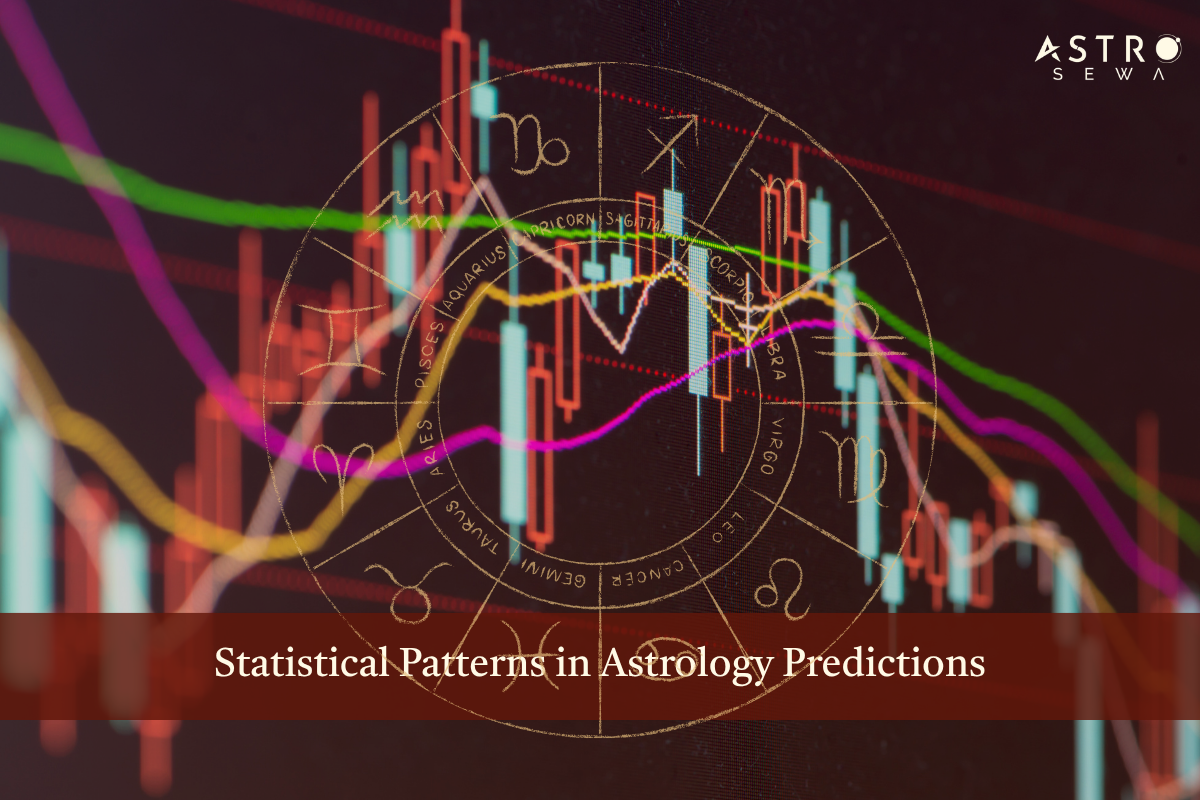
Statistical Patterns in Astrology Predictions: What the Evidence Shows

Key Takeaways
1. Certain astrological patterns, like Saturn transiting the 10th house or Sade Sati, are reported so consistently across thousands of charts and centuries of records that they function as observable statistical patterns even without formal scientific testing.
2. Astrology is difficult to test in the conventional scientific sense because the variables it works with, such as human choices, birth time accuracy, and the skill of the reader, are hard to control.
3. The most honest way to think about astrological predictions is as probability patterns, not certainties. The same planetary combination does not produce exactly the same outcome every time, but it does produce similar themes reliably.
4. Thousands of years of observed patterns by astrologers across generations constitute a form of large-scale pattern recognition, even if it does not meet the standards of modern scientific research.
5. The most sceptical and the most enthusiastic approaches to astrology both miss the point. The evidence suggests that astrology works as a pattern-recognition system, and that is exactly what it has always claimed to be.
If you have ever sat in a room with a group of people and asked how many of them experienced a significant difficulty during their Saturn Dasha or their Sade Sati, you will almost always see most hands go up. This is not scientific proof. But it is a pattern, and it is a pattern that has been observed, recorded, and reported across thousands of years of astrological practice across an enormous number of people.
The question of whether astrology's predictions follow statistical patterns is one of the most genuinely interesting questions in this field. It sits at the intersection of ancient tradition, modern science, and human experience. And the honest answer is not simple.
Astrology cannot be proven by current scientific methods in the way that, say, the effect of a medicine can be proven. But it also cannot be fairly dismissed as random, because the patterns it describes are observed too consistently across too many charts and too many centuries to be entirely coincidental. This article explores what we can honestly say about the statistical patterns in astrological predictions, where the evidence is stronger, and where it is weaker.
What Is a Statistical Pattern?
Before talking about astrology and statistics, it helps to be clear about what a statistical pattern actually means. A statistical pattern is when the same thing tends to happen more often than chance would predict, across a large enough number of cases. It does not mean the thing happens every time. It means it happens consistently enough that the connection is unlikely to be random.
For example, if you flipped a coin 1,000 times and got heads 700 times, that is a statistical pattern. Coins do not always land heads, but getting heads 700 out of 1,000 times is too far from the expected 500 to be explained by random chance. Something is making heads more likely.
When astrologers say that Saturn transiting your Moon brings difficulty, they are not saying it will always bring difficulty for everyone without exception. They are saying that across thousands and thousands of observed cases, this transit more often brings difficulty than it does not. The pattern is not absolute. It is statistical. And that is exactly how serious, experienced Jyotishis have always described it.
Thousands of Years as a Pattern Database
One thing that rarely gets acknowledged in conversations about astrology and statistics is the sheer scale of observation that has gone into building this system. Vedic astrology has been practised continuously for over 5,000 years. In India alone, hundreds of millions of birth charts have been read by trained Jyotishis across that time. Each consultation added to the pool of observed patterns.
The classical texts of Vedic astrology, such as the Brihat Parashara Hora Shastra and the Uttara Kalamrita, were not created by people sitting alone imagining what planets might mean. They were compiled from generations of accumulated observation. When an ancient Jyotishi wrote that a particular planetary combination tends to produce a particular life experience, they were writing from a pattern they had observed repeatedly across many charts and many people's lives.
This is not the same as a modern randomised controlled trial. The ancient astrologers did not have control groups, blinded assessments, or pre-registered hypotheses. But they did have something that modern formal studies often lack:
- enormous sample sizes built up over very long periods of time, and
- a deep professional incentive to record what actually happened rather than what the theory said should happen,
because an astrologer whose predictions were consistently wrong would lose their reputation and their clients.
The patterns that survived this long filter of generations of practice and real-world feedback are the ones that appear most consistently in the classical texts. They are the ones that astrologers today still teach first, because they still show up most reliably in real consultations. That is a form of statistical filtering, even if it was not designed with statistics in mind.
Patterns That Show Up Most Consistently
Some astrological patterns are reported so consistently across so many charts and so many different cultural contexts that they have earned a strong reputation for reliability. The table below maps the most consistently observed patterns and what the evidence from practice shows about each one.
The Gauquelin Studies: The Closest Thing to Scientific Evidence
The most famous attempt to test astrological claims using modern statistical methods was conducted by a French psychologist and statistician named Michel Gauquelin, along with his wife Francoise, across several decades from the 1950s onward. Their work is worth knowing about because it is the most rigorous statistical research into astrology ever conducted, and the results were genuinely surprising.
Gauquelin did not set out to prove astrology. He was initially a sceptic who wanted to show through statistics that astrological claims had no basis. What he found instead was that for certain professions, there was a measurable statistical relationship between the position of Mars, Jupiter, Saturn, and the Moon at the time of birth and the person's career success in specific fields.
The most famous finding was what became known as the Mars effect: the observation that sports champions were significantly more likely than the general population to have been born when Mars was rising or culminating in the sky. His study of over 2,000 sports champions showed this pattern at a level of statistical significance that was hard to dismiss. Similar patterns emerged with Saturn and scientists, Jupiter and actors, and the Moon and writers.
The Gauquelin findings remain controversial. Some attempts to replicate them have shown similar patterns; others have not. There have been debates about methodology, data selection, and interpretation. Modern statisticians are divided.
But what is notable is that Gauquelin's work was rigorous enough that even several scientific bodies that were determined to debunk it had significant difficulty doing so cleanly. This does not prove astrology. But it does suggest that the complete dismissal of any planetary influence on human tendencies may itself be premature.
Why Formal Statistical Testing of Astrology Is Hard
If certain astrological patterns are so consistently observed, why has science not been able to confirm them more definitively? The honest answer is that testing astrological predictions with conventional scientific methods faces several genuine problems that are difficult to solve.
These challenges do not mean astrology is unfalsifiable or untestable in principle. They mean that the kind of clean, controlled experiment that works well for testing a drug does not translate neatly to testing a system that involves human interpretation, individual judgment, and tendencies rather than certainties. A different research methodology is needed, and developing that methodology is genuinely difficult work.