How Does Planetary Transits Affect Your Life?
Key Takeaways
- A transit is simply a planet moving through the sky right now. When a transiting planet passes through one of the 12 houses of your birth chart, it activates the themes of that house for the duration of its stay.
- The most important transits to watch are Jupiter (changes every year and is the most positive influence) and Saturn (changes every 2.5 years and is the most testing). These two shape the broad conditions of your life over months and years.
- A transit's effect is strongest when the transiting planet aspects or conjoins a planet that is already in your birth chart at or near the same degree. This is called hitting a natal planet.
- Transits work alongside your Dasha period, not independently. A Jupiter transit through your 10th house during a Saturn Dasha will still bring improvement but feels more measured than the same transit during a Jupiter Dasha.
- Sade Sati, the 7.5-year period when Saturn transits the three signs around your natal Moon, is the most widely discussed and prepared-for transit in Vedic astrology. Understanding exactly where you are in Sade Sati tells you a great deal about what is currently happening in your life.
Imagine your birth chart as a garden. The seeds of your karma were planted at the moment of birth: certain flowers, certain trees, certain thorny patches. The birth chart shows what is planted there. But the weather changes every day. Rain falls. The sun comes out. Seasons shift. Your garden grows differently in different seasons.
That is what planetary transits are. They are the ever-changing weather of your astrological life. While your birth chart stays fixed, the planets in the sky keep moving, and as they move they pass through the different sections of your chart, activating different parts of your life for the duration of their stay.
What Is a Transit?
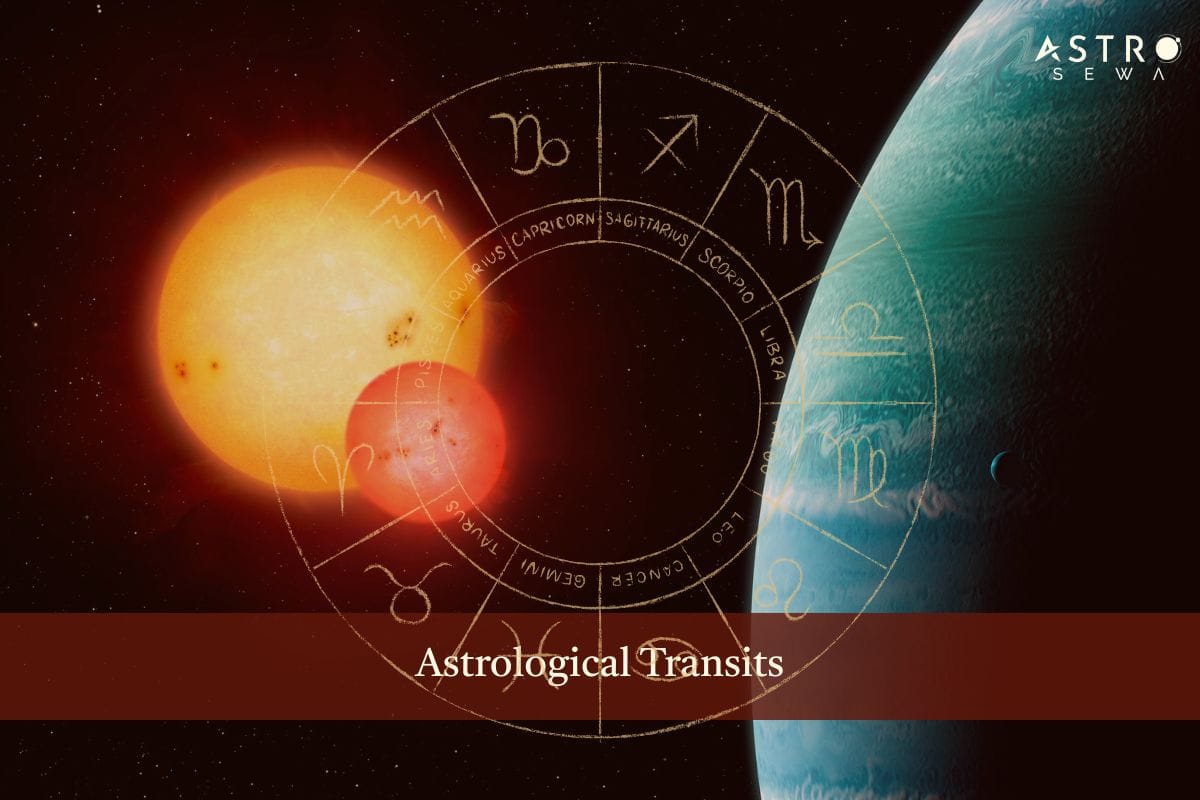
A transit is simply the current movement of a planet through the sky. Right now, as you read this, the planets are moving through different parts of the zodiac. Saturn is somewhere in the sky. Jupiter is somewhere. Mars is somewhere. These current positions are what astrologers call the transit chart.
When a transiting planet moves through a sign that corresponds to one of the 12 houses in your personal birth chart, it is said to be transiting that house. And as it moves through that house, it activates the themes and life areas that house governs.
Think of it like sunlight moving across a room during the day. As the sun moves, different parts of the room are illuminated at different times. A planet transiting through your 7th house is like the light of that planet falling on your relationships and partnerships, making those themes more active, more visible, and more alive during that period.
The duration of the effect depends on how fast the planet moves. The Moon transits through each house in about 2.5 days. Mercury and Venus move through in a few weeks. Jupiter takes about a year. Saturn takes about 2.5 years. Rahu and Ketu each spend about 18 months in a sign. The slower the planet moves, the longer and more significant its transit effect tends to be.
How Transits Actually Work: The House They Visit
The most important factor in reading a transit is which house of your personal chart the transiting planet is passing through. This depends on your Ascendant (rising sign), which determines the house structure of your entire chart.
When Jupiter is transiting through Sagittarius, the effect of that transit depends on which house Sagittarius occupies in your chart. If your Ascendant is Sagittarius, Jupiter is transiting your 1st house, which has a very personal and positive effect on your identity, health, and overall life direction. If your Ascendant is Gemini, Sagittarius is your 7th house, so Jupiter is transiting your relationship and partnership house. If your Ascendant is Virgo, Sagittarius is your 4th house, so Jupiter is activating your home and emotional life.
The same planet transiting the same zodiac sign produces completely different effects for people with different Ascendants. This is why generic horoscopes based only on Sun sign are so much less accurate than personalised chart readings. The house the transit falls in is everything.
All Nine Planets: How They Transit and What They Activate
The table below maps each planet to how long it typically stays in each sign, what areas of life it governs, and how its transit tends to affect your chart.
Some Important Transits that affects your day to day life
1. Jupiter Transits: Your Annual Opportunity Map
Jupiter is the most benefic and positive of all the transiting planets. His one-year stay in each house of your chart is one of the most important annual cycles to track. Knowing which house Jupiter is currently transiting in your chart tells you which area of life is most supported by positive energy, expansion, and good fortune right now.
The table below shows what to expect when Jupiter transits each of the 12 houses in your personal chart.
2. Saturn Transits: The 2.5-Year Test
Saturn's transit through each house of your chart lasts approximately 2.5 years, making it one of the most sustained and significant influences you experience. Understanding which house Saturn is currently transiting tells you which area of your life is being tested, disciplined, and fundamentally restructured right now.
Saturn does not destroy what is solid. He exposes and removes what is weak, built on incomplete foundations, or no longer karmically appropriate. A Saturn transit through your 10th house (career) feels demanding and slow, but what survives it tends to be more genuinely earned and more lasting than what existed before.
3.Sade Sati: Saturn's Most Discussed Transit
Sade Sati is the 7.5-year period that occurs when Saturn transits through the sign just before your natal Moon sign, through your Moon sign itself, and then through the sign just after. Each of these three transits lasts about 2.5 years, hence the total of 7.5 years.
Because the Moon governs the mind and emotions in Vedic astrology, Saturn's prolonged proximity to your natal Moon creates sustained pressure across your emotional life, finances, career, and overall wellbeing. Most people find Sade Sati a genuinely challenging period, particularly the middle phase when Saturn is sitting directly on the natal Moon sign.
However, Sade Sati is not uniformly destructive. Its effect depends heavily on how Saturn is placed in your birth chart. If Saturn is a strong and beneficial planet for your Ascendant, Sade Sati may bring hard work and heavy responsibility but also genuine achievement. If Saturn is poorly placed in your chart, the Sade Sati period tends to feel more difficult.
Knowing exactly which phase of Sade Sati you are in right now (before, during, or after the Moon sign transit) is very useful practical information. The first phase (Saturn in the sign before your Moon) tends to bring career and financial pressure. The middle phase (Saturn on your Moon sign) is usually the most emotionally and personally demanding. The final phase (Saturn in the sign after your Moon) is often a period of gradual recovery and rebuilding.
4. Rahu and Ketu Transits: 18 Months of Disruption or Opportunity
Rahu and Ketu always move together in opposite signs, spending approximately 18 months in each pair of opposite signs before shifting. Their transits are among the more significant because Rahu amplifies desire and brings sudden change while Ketu creates detachment and unexpected loss or gain, depending on the chart.
When Rahu transits through your 10th house, career matters become intensely important and potentially unstable. Rapid rises and sudden falls are both possible. When Rahu transits through your 7th house, relationships become complicated and unpredictable. When Ketu moves through the same houses, the effect tends to be one of withdrawal, unexpected endings, or a spiritual shift in how you relate to those life areas.
The Rahu-Ketu axis every 18 months is also connected to the eclipse cycle. Solar and lunar eclipses happen along the Rahu-Ketu axis, and when an eclipse falls close to a sensitive point in your birth chart (particularly your natal Sun, Moon, or Ascendant), it can trigger significant events in the weeks immediately following.
Frequently Asked Questions
What is the difference between a birth chart and a transit chart?
Your birth chart is fixed. It shows the positions of all the planets at the exact moment and place of your birth, and it never changes. A transit chart shows where all the planets are right now in the sky. When astrologers talk about transits, they are comparing the current positions of the planets (the transit chart) to the fixed positions in your birth chart, to see which planets are activating which parts of your personal chart at this moment.
Which planet's transit matters most?
Jupiter and Saturn are the most important transits to track because they are slow-moving enough to have sustained effects lasting months to years. Jupiter's one-year transit through each house is the most positive and opportunity-creating influence. Saturn's 2.5-year transit is the most testing and restructuring. After these two, Rahu and Ketu's 18-month transits are significant for sudden change and spiritual shifts. The Moon's daily transit creates the moment-to-moment emotional background of each day.
How do I know which house a transiting planet is in for my chart?
You need to know your Ascendant (rising sign), which determines the house structure of your chart. If your Ascendant is Aries, then Aries is your 1st house, Taurus is your 2nd house, and so on around the zodiac. When you know which zodiac sign a planet is currently transiting (any astrology app shows this), you count from your Ascendant to find which house that sign occupies in your chart. That tells you which house the transit is activating.
What is Sade Sati and how do I know if I am in it?
Sade Sati is the 7.5-year period when Saturn transits through the three signs closest to your natal Moon sign: the sign before, your Moon sign itself, and the sign after. To know if you are in Sade Sati, you need to know your Vedic Moon sign and then check where Saturn is currently transiting in the sky. If Saturn is in any of those three signs, you are in Sade Sati. Our astrologers at Astrosewa can confirm this instantly from your birth details and tell you which phase you are in.
How can Astrosewa help me understand my current transits?
Our astrologers will identify every significant transit currently active in your chart, tell you which house each major planet is transiting and what that means for your life right now, identify any planet-to-natal-planet hits that are creating significant personal effects at this moment, and explain how your current transits interact with your Dasha period to give you the complete timing picture. Book through the Astrosewa app with your full birth details for a personalised reading delivered within 48 hours.