A Simple Guide to Astrology Houses

Key Takeaways
1. The 12 houses divide your birth chart into 12 departments of life. Each house covers specific life areas, and the planets sitting in each house shape how those areas unfold for you personally.
2. The 1st house (your Ascendant or rising sign) is the most important house because it sets the structure for all the other 11 houses and shows your overall physical and personal constitution.
3. Houses are grouped in important ways: Kendra houses (1st, 4th, 7th, 10th) are the four pillars of life. Trikona houses (1st, 5th, 9th) are the luckiest. Dusthana houses (6th, 8th, 12th) are the most challenging.
4. When a planet transits through a house, it activates that house's themes for the duration of its stay. This is why transits are one of the most important timing tools in Vedic astrology.
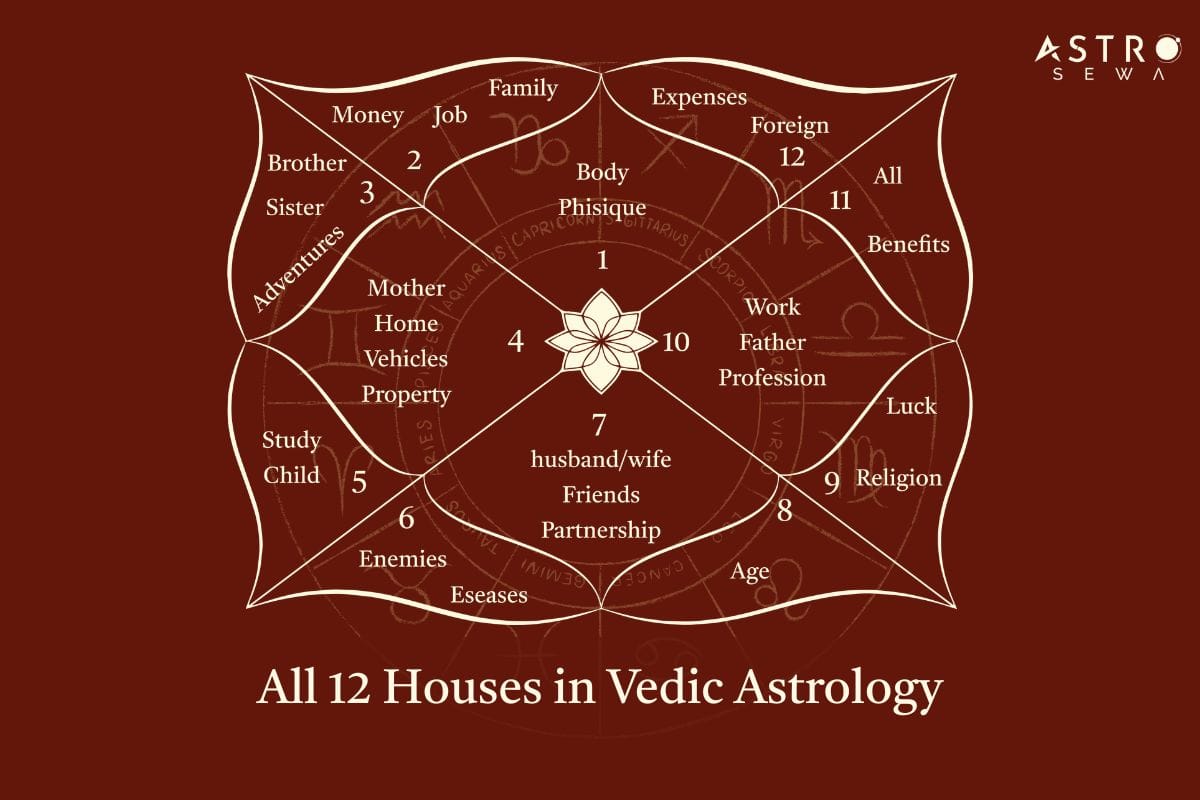
When most people first look at a Vedic birth chart, it looks like a grid or a diamond divided into sections with numbers and symbols scattered throughout. It can feel overwhelming. But underneath the visual complexity, the chart is actually quite simple in its structure. It is divided into 12 sections called houses, and each house covers a different department of your life.
How Houses Are Created in Your Chart?
Every birth chart starts with one key piece of information: the rising sign, also called the Ascendant or Lagna. This is the zodiac sign that was rising on the eastern horizon at the exact moment and place of your birth. The rising sign becomes your 1st house. The next sign in the zodiac becomes your 2nd house. The one after that becomes your 3rd, and so on around the chart until all 12 signs are placed across all 12 houses.
This is why birth time is so important in Vedic astrology. The rising sign changes roughly every two hours as the Earth rotates. Two people born on the same day but four hours apart can have completely different rising signs and therefore completely different house structures. The same planet sitting in completely different houses for two people born close together produces completely different readings.
Each house is also ruled by a planet. The planet ruling the sign that occupies a particular house is called the lord of that house. The lord's position in the chart adds another layer of information. For example, if your 7th house (marriage) is occupied by the sign Aries, the 7th house lord is Mars, because Mars rules Aries. Where Mars is placed in the rest of your chart tells you a great deal about how your marriage and partnerships will unfold.
All 12 Houses: The Complete Simple Reference
The table below gives you everything you need to understand each house at a glance: its Sanskrit name, what it covers in plain language, the key life areas it governs, and a simple way to remember its core meaning.
How Planets Interact With Houses?
The real reading of a birth chart comes from understanding not just what each house means, but what happens when specific planets are placed in specific houses. Every planet adds its own quality to whatever house it occupies. And some planets are more comfortable in certain houses than others.
The table below shows each planet, the houses where it tends to do well, the houses where it faces more difficulty, and what quality it adds to any house it occupies.
A House-by-House Guide: Going Deeper
1st House: The Foundation of Everything
The 1st house is the starting point of your entire chart. It covers your physical body, your overall health and vitality, your core personality, and the immediate impression you make on the world. More than any other house, the 1st house shapes everything else, because your rising sign and the planets in the 1st house determine the whole structure of how every other house falls. A strong 1st house and a healthy Ascendant give you a stable foundation for navigating every area of life.
2nd House: Your Financial Foundation
The 2nd house covers the wealth you accumulate over time, your family of origin, your voice and the way you speak, and your relationship with food. It is the storehouse of your resources: what you gather and hold. An astrologer reading your 2nd house can tell you about your relationship with money, whether you tend to save or spend it, the quality of your family life, and how your speech and communication style presents to the world.
3rd House: Your Drive and Daily Life
The 3rd house covers your courage and willpower, your relationship with younger siblings, short trips and journeys, your hands and arms, your writing and communication skills, and your ability to take initiative in daily life. A strong 3rd house gives boldness, practical skill, and the determination to act on your ideas. This house is also strongly associated with creative writing, journalism, media, and any work that requires using your hands or your voice as a primary tool.
4th House: Your Emotional Home
The 4th house is the house of your inner world. It covers your physical home and where you live, your relationship with your mother, your emotional comfort and peace of mind, the land and property you own, and your vehicles. This house represents your roots: where you come from and what makes you feel safe. A strong 4th house gives deep emotional stability and a secure home life. A troubled 4th house can mean a difficult relationship with the home, the mother, or a persistent sense of inner unease.
5th House: Your Joy and Creativity
The 5th house is often called the house of joy. It covers your children, your intelligence and mental gifts, your creative talents, education, romance and love affairs, and the merit you carry from past lives into this one. It also governs investments and speculation, because these require the kind of intelligent risk-taking that the 5th house supports. A strong 5th house tends to produce sharp intelligence, creative gifts, fortunate relationships with children, and a general sense of life having a meaningful and enjoyable creative direction.
6th House: Your Strength Against Obstacles
The 6th house deals with everything that challenges you: illness, legal disputes, debts, enemies, and competitors. It also governs your daily work routine and your capacity for service. While the 6th house has a reputation as a difficult house, its strength is the strength of the fighter. A well-placed 6th house lord gives the ability to overcome adversity, win legal battles, defeat competitors, and recover from illness. It is the house that determines how resilient you are when life gets hard.
7th House: Your Relationships
The 7th house covers all your close one-to-one relationships: your marriage partner, your business partners, and anyone with whom you are in a formal, committed relationship of any kind. It also governs your open opponents, meaning those who oppose you directly and publicly. The quality of the 7th house and its lord shapes the entire experience of your partnerships: how easily you find them, how harmonious they are, and what challenges they bring.
8th House: Transformation and What Lies Beneath
The 8th house is one of the most complex and misunderstood in the chart. It governs sudden events and unexpected changes, secrets and hidden matters, inheritance, surgery and medical interventions, chronic illness, the deeper mysteries of life and death, and the occult. Most importantly, it governs transformation: the deep changes that life puts us through that we could not have anticipated or chosen. People with a strong 8th house often have unusual insight into what is hidden and a genuine gift for understanding the deeper layers of human experience.
9th House: Your Fortune and Dharma
The 9th house is consistently considered one of the most fortunate in the chart. It covers your luck and overall life fortune, your father, your teachers and spiritual guides, long journeys and foreign travel, higher education and philosophy, and your sense of dharma: what you are here to do and the deeper purpose your life serves. A strong 9th house, particularly with a well-placed 9th lord, is one of the clearest indicators of a fortunate and purposeful life.
10th House: Your Career and Impact
The 10th house is the house of your work in the world. It covers your career and profession, your public reputation, the authority and status you hold in society, and your most significant achievements. This is the house that determines what kind of work you do, how successful you are in it, and how the world at large sees and values your contribution. The 10th lord's position and the planets in the 10th house are the primary indicators in any career-related reading.
11th House: Your Gains and Community
The 11th house is the house of income and material gains. It covers the regular money that flows into your life, your social network and friendships, your older siblings, and the fulfilment of your desires and wishes. A strong 11th house with a well-placed 11th lord is one of the best indicators of financial flow and social support. The 11th house is always read alongside the 2nd (savings) and 10th (career) to give the full picture of a person's financial life.
12th House: Letting Go and Spiritual Freedom
The 12th house covers everything that lies beyond the ordinary world. It governs your expenses and financial losses, your time spent in foreign countries, hospitalisation and times of isolation, sleep and the realm of dreams, spiritual practice and the path toward liberation or moksha, and your hidden or secret life. The 12th house has a complex reputation because it governs loss and expenditure. But it also governs the deepest spiritual freedom and the connection to the divine that transcends ordinary worldly experience. Many deeply spiritual, compassionate, and creatively gifted people have a strong 12th house.